
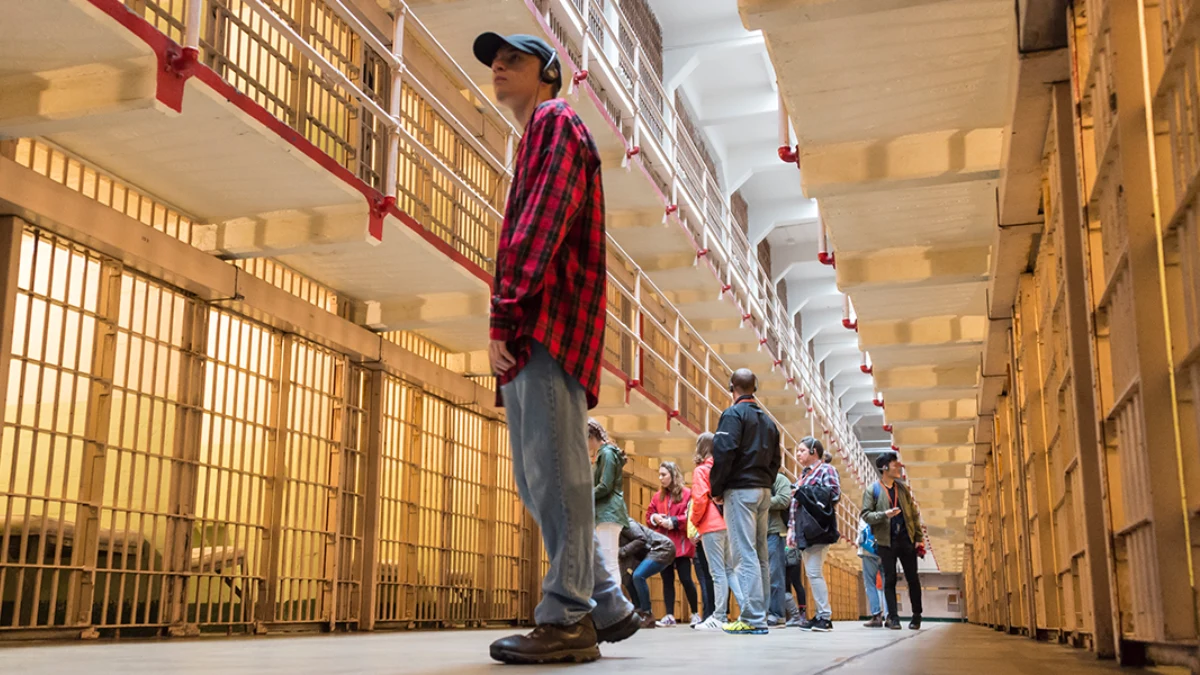
Doing Time: The Alcatraz Cellhouse Tour – A must-do experience for visitors
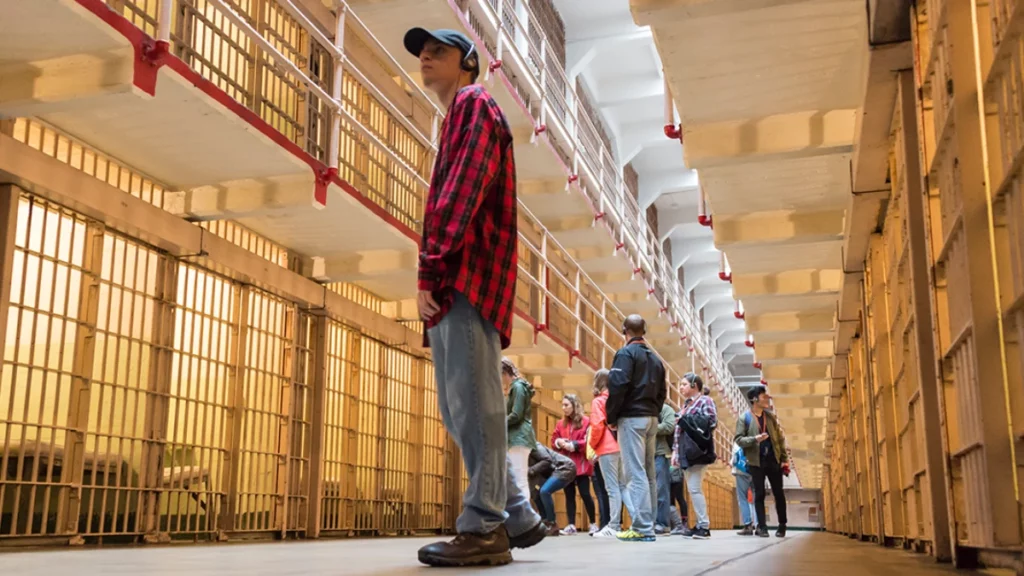
When you step onto Alcatraz Island, you are entering one of the most infamous prisons in American history. And there is no better way to experience it than through the award-winning audio tour, “Doing Time: The Alcatraz Cellhouse Tour.”
This immersive tour takes you inside the walls of the Cellhouse, where real former inmates and correctional officers share firsthand accounts of life on “The Rock.”
If you plan a visit to Alcatraz, here is everything you need to know about this must-do tour.
Top Tickets
– Alcatraz Day Tour
– Alcatraz Night Tour
– San Francisco Bay Cruise (no landing)
– Muir Woods, Sausalito & Alcatraz
– Muir Woods, Sausalito & Alcatraz + SFO city tourBook tickets early, as Alcatraz Island tours sell out quickly.
Table of Contents
What is the “Doing Time: The Alcatraz Cellhouse Tour”?
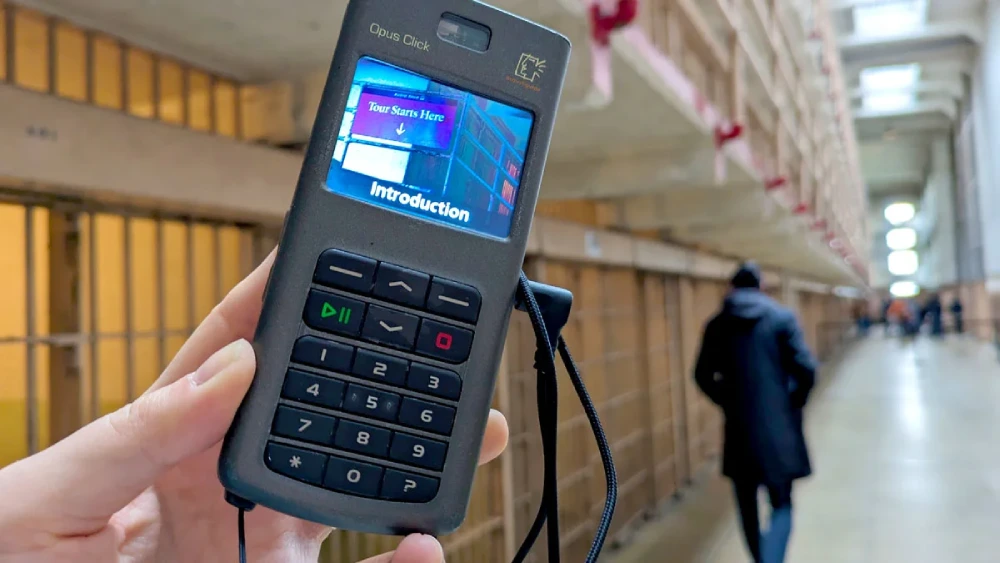
This is the Cellhouse audio tour device, which you get at Alcatraz. Image: Afternoonteareads.com
The Alcatraz Cellhouse Audio Tour is a 35 to 45-minute self-guided audio tour that leads you through the prison’s main cellhouse.
You will hear gripping stories about the prison’s operations, daring escape attempts, and the everyday lives of the men who lived and worked there.
Narrated by four former inmates and four former correctional officers, this tour brings Alcatraz to life in a way that no written exhibit ever could.
The sound effects—clanging cell doors, echoing footsteps, and distant voices—make it feel as if you have stepped back in time.
Important: Cellhouse Tour is included in your Alcatraz ferry ticket. You don’t have to pay extra.
The 8-member cast of the Cellhouse tour
The power of this tour lies in its narration through the eyes of people who spent time at Alcatraz.
While you might hear other snippets or a narrator guiding you between stops, the core storytellers are:
Four former correctional officers
- Patrick Mahoney: A correctional officer who provides much of the “operational” narration. He worked on the island from 1956 until it closed in 1963. He famously notes that Alcatraz was the only prison where “you could see what you were missing” (referring to the view of San Francisco).
- Philip Bergen: Captain of the Guards (Associate Warden). He provides the “command” perspective on security and discipline.
- George DeVincenzi: A correctional officer who famously narrates the story of the “spaghetti riot.”
- Ron Marquart: A correctional officer who served during the prison’s later years.
Four former inmates
- Leon “Whitey” Thompson (AZ-1465): A bank robber who provides some of the most emotional commentary about the psychological toll of prison. He describes the psychological torture of hearing the New Year’s Eve parties from the yacht club across the water.
- Jim Quillen (AZ-586): A kidnapper/robber who describes the brutality of solitary confinement (“The Hole”) and later became a key figure in Alcatraz history meetings.
- John Banner (AZ-?): Known for his descriptions of the “silence” rule and the daily grind.
- Darwin Coon (AZ-1422): A bank robber who offers insights into the “Battle of Alcatraz” and the clever ways inmates communicated.
Where to pick up & start the cellhouse tour?
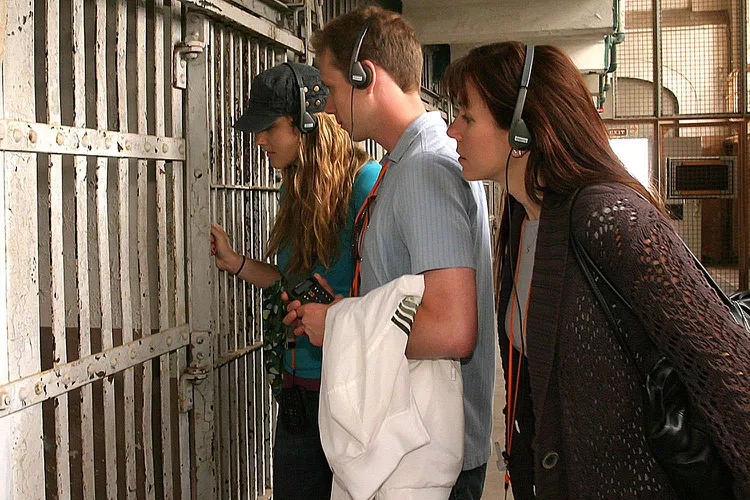
You won’t get the audio tour when you board the Alcatraz ferry from the mainland.
Once you disembark at the dock, you will walk approximately 1/4 mile (400m) to the main prison building.
Once you enter the massive concrete building, the Ranger will guide you to the Shower Room (an open area with showerheads still visible on the ceiling/walls).
You will notice a queue in front of the counter for the Cellhouse tour in the Shower Room. As you reach the front of the queue, one of the Rangers will hand you the device and headset.
You put on the headset right there in the Shower Room; the audio narration begins by describing the room you are standing in.
Pro Tip: The audio guide is available in 11 languages: English, Spanish, French, German, Italian, Dutch, Japanese, Korean, Mandarin, Portuguese, and Russian. If you need the Cell House tour in a specific language, ask the staff member as they hand you the device.
Alcatraz Cellhouse audio tour – every stop in detail
Alcatraz’s Cellhouse audio tour follows a specific physical path. Here is the “Director’s Cut” of what to look for at each major stop.
1. The Shower Room

The Shower Room is where you start your Cellhouse audio tour. It is large and open, designed to make you feel humiliated and exposed.
You can still see the soap boxes the prisoners used.
Listen to the story about water temperature on the audio guide. In the early days of the prison, all inmates had access to hot showers.
It wasn’t a luxury but a strategic decision by the warden.
He feared that if the inmates grew accustomed to cold water, they might be able to survive the freezing waters of San Francisco Bay.
2. “The Broadway”
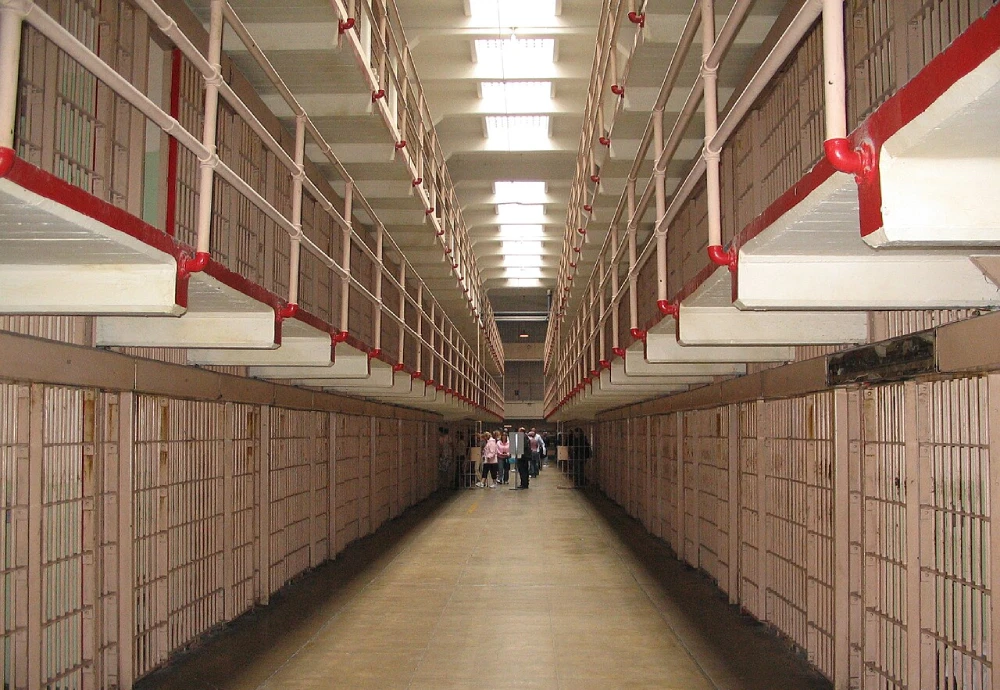
The central hallway between Cell Block B and Cell Block C is known as “Broadway.”
The audio guide narrates how the inmates were forced to shine the concerte floor of the broadway until it had a mirror finish.
At the end of this hallway, you will see a clock. This area was called “Times Square.”
Inmates watched this clock obsessively – the moving hands were the only proof that time was actually passing.
3. The Cells (Standard Housing)

Walk along and look into the standard cells. They are small, measuring only 5 feet wide by 9 feet long.
Notice the small shelves inside. Inmates were allowed to have paint supplies. The audio guide tells stories about this privilege. You will hear how some inmates, like the famous “Birdman,” had these privileges taken away.
Look at the back wall of the cells. You will see small metal vents or grilles. Pay attention to these. They are very important for a story later in the tour about the famous “Escape of 1962.”
4. The Recreation Yard
Visitors find the recreation yard the most emotional stop on the tour because the moment you step into the open, you realize this was the only luxury the inmates had.
From the yard, the inmates could see the Golden Gate Bridge and the city of San Francisco nearby. This proximity was a form of psychological torture for them.
While exploring the yard, you will hear an inmate describe New Year’s Eve on the island.
If the wind blew the right way, sounds carried across the water from the mainland. They could hear music and women laughing at the St. Francis Yacht Club. Hearing life go on just out of reach was considered the worst punishment of all.
The prisoners used the concrete steps in the yard as bleachers.
The most powerful inmates, known as the “upper crust,” controlled the bridge tables.
5. The Battle of ’46 (C-Block)
This stop covers the famous “Battle of Alcatraz” which happened in May 1946.
It began as an escape attempt, then failed and turned into a long siege.
The Cell House tour guides you to a specific spot in Cell Block C, where pockmarks and divots in the concrete mark the floor.
They are impact craters from the mortar shells and grenades that US Marines dropped through the roof ventilators to kill the rioting inmates below.
Don’t miss the corridor where Officer William Miller was held hostage and eventually killed.
6. The Dining Hall (The Mess Hall)
Once in the Dining Hall, look up at the ceiling to see tear gas canisters.
The plan was to detonate them remotely in case of a riot, but that situation never arose.
The audio tour mentions a specific riot sparked by inmates angry about the spaghetti’s poor quality.

Look around for the “shadow board” used for kitchen knives. Every knife had a painted outline behind it on the board. If a knife was missing, it was easy to spot (thanks to its visible outline), and no one was allowed to leave the room until the wardens found it.
7. The Great Escape (1962)
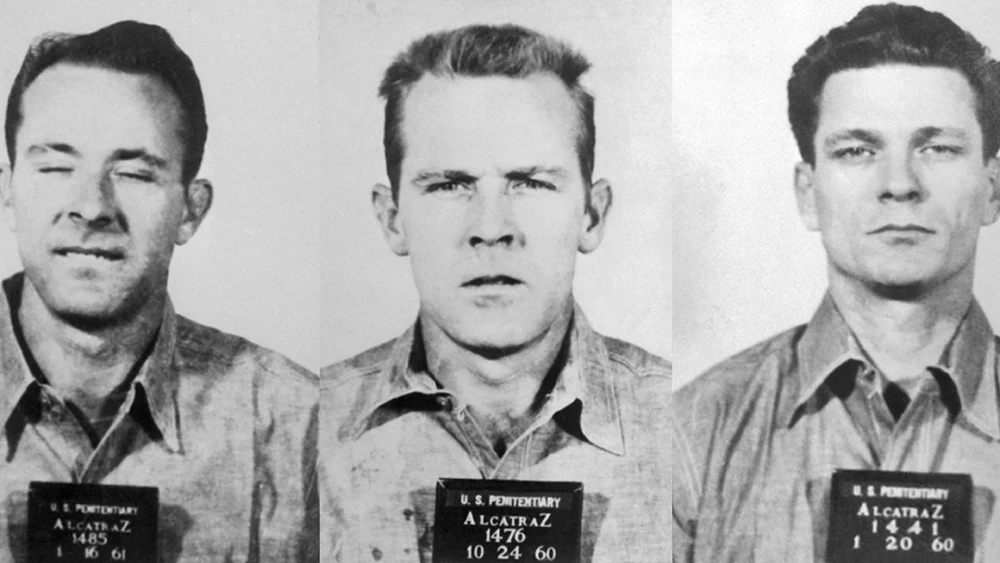
This stop focuses on the famous escape attempt in 1962. You will stand in front of the cells that belonged to Frank Morris and the Anglin brothers.
During their escape attempt, the inmates made the heads out of papier-mâché and placed them on their beds to fool the guards. Today, you can see recreations of dummy heads created by the National Park Service.
If you look closely at the vent grille at the back of the cell, you will see a fake “bolt” made of soap.
The inmates used this soap bolt to hold the grille in place, so the wardens couldn’t figure out they had cut away the surrounding concrete.
The audio guide describes the tools they used: they stole a spoon handle from the mess hall, combined it with a vacuum cleaner motor, and built a homemade drill.
Behind the Scenes Areas
These areas of Alcatraz Island are only accessible if you book the specific Behind the Scenes tour or the Night Tour.
The Dungeon (Citadel)
The Dungeon is located underneath the main cellhouse. These were the original cells on the island, dating back to the 1860s, when Alcatraz was a military fort.
The atmosphere down here is wet, dark, and terrifying. In the past, unruly inmates used to be chained to the walls here in total darkness.
The Gun Gallery
If you look up above the main cell floor, you will see an elevated, caged walkway. Armed guards patrolled this area with rifles.
Being high up gave them a tactical advantage known as the “high ground.” From here, they could shoot down into any cell or into the dining hall if necessary.
But the Gan Gallery wasn’t as secure as the planners thought it was.
During the “Battle of ’46,” an inmate named Bernie Coy climbed the bars to reach it. He used a homemade tool called a “bar spreader,” which he made from toilet fixtures. He used the tool to squeeze between the bars and get into the gallery. Once inside, he overpowered the guard and seized the weapons.
Expert tips for the “perfect” visit
The “Slam” Demo: The audio tour is self-paced, but the Park Rangers do a live demonstration of the cell door mechanism (usually twice a day). Take off your headphones for this. Hearing the mechanical crash of the steel bars (the “slammer”) is visceral and deafening.
Pause at “The Hole”: When the audio guide takes you to D-Block (Solitary), pause the tape. Step into one of the open solitary cells. Close your eyes. The audio guide describes the darkness, but feeling the cold, damp air yourself adds a layer of reality.
Look for “The Snitch Box”: On your way out of the Dining Hall, look for a small metal detector box. It is primitive by today’s standards, but was high-tech in the 1950s.
Find the Gardens: On your walk back down, notice the blooming flowers. These were tended by inmates. For many, gardening was the only way to touch something “living” and “soft” in a world of concrete and steel.
Is the Alcatraz Audio Tour worth it?
Absolutely! Tourists who have explored Alcatraz’s Cellhouse using the audio guide often say it is the best audio tour they have ever experienced.
One of the main reasons is that it is incredibly engaging. The mix of real voices, sound effects, and stories brings history to life in a way that feels immersive. It also offers an authentic experience, as you’ll hear firsthand accounts from people who actually lived or worked in Alcatraz.
The tour is easy to follow, with clear directions guiding you through the prison so you don’t miss any important details. Best of all, the audio guide is included in your ticket at no extra cost, making it a fantastic value.
